An arborist and a tree surgeon both work on trees, and in the UK the terms are largely interchangeable. “Arborist” emphasises trained, science-led tree care, the study of how trees grow, fail and recover, while “tree surgeon” is the everyday British term for the practical work of felling, pruning and dismantling. In practice, most UK firms are both, and a qualified arborist may also work as a consultant who surveys and reports on trees rather than cutting them.
That's the short answer for anyone wondering what the difference is. (And yes, homeowners really do search “tree surgeon vs arborist: what's the difference”.) But if you run a tree surgery business, there's a more useful question hiding underneath it: which word should you actually use in your marketing? We'll get to that, it matters more than most owners realise.
What Is an Arborist?
An arborist is someone trained in arboriculture, the cultivation, management and study of individual trees. The emphasis is on tree health and understanding trees as living systems: when to prune trees and when to leave well alone, how decay or a pest infestation spreads, which species tolerate crown reduction and which resent it (a fruit tree takes hard pruning far better than a mature beech), and when a tree can be saved rather than felled.
In the UK, that training typically shows up as arboriculture qualifications (Level 2 through to degree level), NPTC/LANTRA certificates for chainsaw and aerial work, and membership or approval schemes such as the Arboricultural Association's ARB Approved Contractor status, with work carried out to industry standards like BS 3998 (the British standard for tree work). You'll also see “arboriculturalist” used to mean the same thing, and in the US the International Society of Arboriculture's ISA Certified Arborist credential is the best-known equivalent. No single qualification defines the title, each certificate simply proves technical competence in one part of the job.
Some arborists specialise entirely in advice rather than cutting. A consulting arborist carries out tree condition surveys, decay detection, mortgage and insurance reports, BS 5837 tree surveys for planning applications, and guidance on Tree Preservation Orders and conservation areas. If a developer needs to know which trees on a plot must be protected, or a homeowner needs formal advice before felling a mature tree in a conservation area, a consulting arborist assesses the tree's health and writes the report, and often never picks up a saw.
What Is a Tree Surgeon?
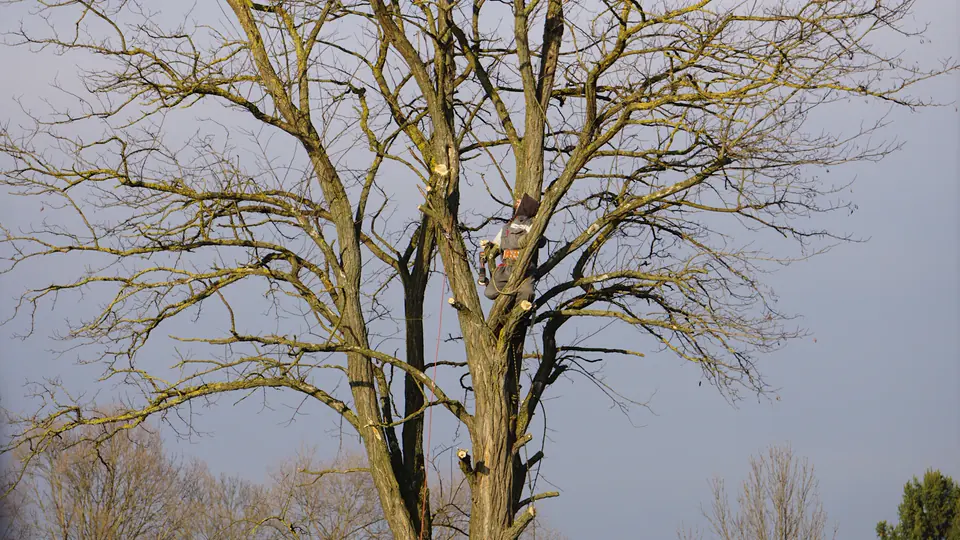
“Tree surgeon” is the term British homeowners have used for decades to describe the hands-on trade: tree felling and dismantling, crown reductions, crown thinning and lifts, tree pruning, deadwood removal, hedge work, stump grinding and stump removal, and emergency storm damage response. It's the person in a harness at thirty feet with a chainsaw, and the team feeding the chipper below.
The name borrows from medicine, surgery on trees, and it stuck because it describes what customers actually see: skilled, physical, sometimes dangerous work carried out on their property. It says nothing about qualifications either way. A tree surgeon may hold every certificate going, or none, which is why public liability insurance and NPTC tickets matter far more than the job title, they, along with sound health and safety practice, are what separate a qualified tree surgeon from a stranger with a chainsaw. A good tree surgeon can tell you at a glance whether to prune, thin or fell, and will happily show the paperwork proving they can do any of the three safely.
Why Most UK Firms Are Both
Here's where the neat distinction collapses, and why the two terms are so often used interchangeably. Almost every reputable tree surgery firm in the UK is run by qualified arborists doing tree surgery. The person quoting your crown reduction has studied arboriculture; the person carrying it out holds aerial cutting certificates. Arborists and tree surgeons are, for the most part, the same people described from different angles, one label points at the knowledge, the other at the work.
Neither title is legally protected, so anyone can use either. That's exactly why established tree surgeons and arborists tend to use both: “tree surgeon” so customers recognise the trade, and “arborist” to signal that there's genuine training behind it. The more useful distinction is whether someone holds the qualifications for the work.
Which Term Should Your Marketing Use?
Now the part that earns this article its place on a marketing blog. If you run a tree surgery business, the rule is simple: use the words your customers use. Most customers don't know the difference between the two titles and don't need to, your job is to meet them where they search, then give them enough to make an informed decision that you're the right tree surgeon for the job.
UK homeowners overwhelmingly search for “tree surgeon” when they need tree work done. A customer who thinks they need an arborist and one who knows they need a tree surgeon are almost always after the same thing, someone qualified to handle the pruning or felling of a tree on their property. “Arborist” is more common in the US, where firms often trade as a tree service, and within the industry itself, but among the British public it attracts far fewer searches. If your homepage title, service pages, Google Business Profile category and ad keywords are built around “arborist”, you're competing for a fraction of the demand while your competitors collect the rest.
So split the job the terms do:
- “Tree surgeon” for visibility. Page titles, H1s, service page copy, local SEO targeting and Google Ads keywords should lead with the term people type into Google.
- “Arborist” for credibility. Use it in your about page, your qualifications section and your quotes, “our NPTC-qualified arborists” reads as professional precisely because it's the industry's own word.
This is the same principle that underpins all good SEO for tree surgeons: rank for the language of the customer, then reassure them with the language of the professional once they arrive.
One caveat: if consultancy work is a genuine service line, BS 5837 surveys, specialist tree reports, TPO applications, give it its own page and use “consulting arborist” and “arboricultural consultant” there, because that's what those buyers (architects, developers, solicitors) actually search for. Match the term to the audience, page by page.
If you're not sure which terms your own site should be targeting, get in touch, we're specialists in growing tree surgery businesses, and a free audit will show you exactly where the demand in your area sits.
Frequently Asked Questions
Is an arborist more qualified than a tree surgeon?
Not necessarily. Neither title is legally protected in the UK, so anyone can call themselves either. What matters is the qualifications and insurance behind the name, NPTC/LANTRA certificates for chainsaw and aerial work, arboriculture qualifications such as a Level 2, 4 or 6 award, and Arboricultural Association approval. A well-qualified professional may use either term, so judge a business on its credentials, not the word on the van.
Should my business be called an arborist or a tree surgeon?
Use both, but in different places. UK homeowners overwhelmingly search for “tree surgeon”, so that should be the primary term in your page titles, headings, Google Business Profile category and ad keywords. Use “arborist” and “arboriculture” in your supporting copy, your about page, qualifications section and service descriptions, where it signals training and professionalism without costing you visibility.
What is a consulting arborist?
A consulting arborist advises on trees rather than cutting them. Typical work includes tree condition surveys and safety inspections, BS 5837 tree surveys for planning applications, decay detection, mortgage and insurance reports, and advice on Tree Preservation Orders and conservation areas. They produce reports and recommendations, which a tree surgery team then carries out on site.